Tuesday, September 10, 2019

HISTORY: COFFEE MUGS

It's the year 1475 and the great city of Constantinople has been under Ottoman control for over twenty years. The dome of the Church of the Holy Wisdom - the Hagia Sofia - is now a place for muslim worship.

But that is not your concern today - instead you stroll through the narrow streets in search of a newly opened establishment - the Kiva Han - possibly the world's first coffee shop. You smell the aroma of the strong Turkish coffee before you even set eyes upon the place. You step inside, find a table and soon the black and unfiltered liquid arrives, contained in a wooden mug - a coffee mug.

Of course wood is not an entirely suitable agent in which to keep coffee and those early wooden mugs must have been a sight to behold - their interiors likely stained as black as the liquid gold they contained. Eventually porcelain, invented in China around 600 A.D. (hence “china” or “fine china”), and other ceramics became the preferred material for mugs.

However what we take as the classic coffee mug of today is not as old as you may think. The 'traditional' coffee mug arrived in 1945 - a product of the Victor Insulator Company in the USA. WW2 had dictated the design of the company's mugs in terms of being able to take a hard knock or two, not slide about on a pitching ship and sported thick walls for insulation in colder climes. These mugs' heavy duty style became very popular after the war and were known as the 'Dinner Coffee Mug'

Of course today, as consumers, we're spoilt for choice. Coffee mugs now are manufactured in metal, glass, plastic, earthenware - you name it. They're everywhere, in every household, in every office (well, perhaps not in Utah) and your favorite coffee mug can be a source of comfort and welcome routine.

As a designer, I'm pleased to be able to offer a range of coffee mugs suitable for your own enjoyment or to give as a gift to that someone special.

Must be time for a coffee?

MADJACK TEES coffee mug collection on Zazzle

MADJACK TEES coffee mug collection on Redbubble


Wednesday, August 21, 2019

HISTORY: LOUIS WAIN AND THE VICTORIAN CAT MEME

Dogs are ok, but cats are my sort of thing.

As such they're fertile ground for new tees, stickers and other gifts.

Have recently discovered a British artist from Victorian times by the name of Louis Wain (lived from 1860 to 1939).

Wain's specialty was to draw anthropomorphized cats in various (human) social situations - or even just jolly single portraits. His work was extremely popular.

Unfortunately in his later years he may have suffered from schizophrenia. But even then it didn't stop him from continuing to produce illustrations although they became more and more fantastical.

At his height as an artist, his kitties had their own yearly anthologies and I guess you could say his works were the cat memes of their time. H. G. Wells said of him, "He has made the cat his own. He invented a cat style, a cat society, a whole cat world. English cats that do not look and live like Louis Wain cats are ashamed of themselves."

His works are out of copyright now and so I've been adapting a few to t-shirt designs and they're proving to be quite popular.

It's a small selection and not likely to become extensive, but have recently added a sad blue kitty which is one of my favorites.

Check it out in the Unexpected Kittahs collection - link below.

<edit> look for a movie about Louis Wain, starring Benedict Cumberbatch to be released probably late 2019.


REDBUBBLE: SAD KITTY BUDDY

Thursday, March 13, 2008

The Waikato Times cartoonist and me.

I'm a graphic designer.

I like artwork to be aesthetically pleasing, well crafted and where possible, display artistic talent. I like orderliness but also enjoy highly abstract works of art. As long as there’s passion you might say.

Now have a look at this;

This is a cartoon from the Waikato Times, the local rag that is put out six days a week covering the Waikato Region of the North Island of New Zealand (a small country to the east of Australia).

The Waikato Times has a venerable history. It was first published in 1872 and has offices in the region's largest city, Hamilton. It has a circulation of 41,000 copies and there is essentially no other local paper of size in the area to oppose it. So it can ask for suggestions, which it does, and then add your missive to the vast collection it keeps stored at the bottom of the local landfill (for safekeeping).

The panel above is from a local cartoonist who goes by the name of ‘Hawkey’. His works appear in the paper something like five or four days out of seven, so he’s the paper’s chief cartoonist.

Here's another quality Hawkey cartoon;

I don't know what to make of this. This is what passes for biting satirical content and cartoon artistry in our main newspaper five days a week. I'm ashamed.

Here's another;

Leaving aside the flat perspective, the monotonous use of colour, the sheer awfulness of the characters - what is up with that car? Really? What is that? Do I detect doors that open up from the middle? No. Or is it a ‘coupe’ as only the front seats appear to have doors? Actually, I know what it is. It's a Morris Minor. Have another look. It's a ‘morry’, a car that was popular in the 1950's and 60’s, seen here oddly twisted by some dim recognition that cars have since become more aerodynamic, but a recognition unable to be properly expressed nonetheless.

Here’s another example of the artist’s inability to deal with modern technology.

F*ck me, look at that.

Here’s another (in a more general vein)

Don’t worry about the joke – it isn’t funny.

Again, there’s the flat perspective adding to the dreariness of the scene and the unappealing style of the characters. But my main complaint here is that I don’t recognize this as a Waikato scene. Maybe I don’t get out enough, but are these Waikato people? Do we really have publicans who wear bowties while pulling pints for the ‘locals’? Or has the above more in common with the cartoon below?

If you're living in the Waikato, have a closer look at Hawkey's cartoons when they appear. Really, is this the best the Waikato Times can do?

And finally;

Yes - they actually published this .

Leaving Hawkey’s artistic shortcomings aside, Waikato people simply don't look like this. We don't put on greatcoats when we go out (except for the odd student who frequents op-shops). Our womenfolk don’t generally wear aprons when they venture out to the postbox because they’ve spent all day baking! Our petrol pumps no longer have the nozzle attached to the top of the pump. A great number of us don’t wear ties at work anymore and a bowtie wearer is a distinct oddity. Our cars are not shaped like boxes (unless it’s a designer statement) and we have a large number of brown/olive people living here as well. In short, we’re not bloody English and it’s not the 1950’s anymore!

A suggestion?

Cut back Hawkey’s contributions to once a week – give him more time to work on his creations. And hire some new blood for god’s sake. In short, get cartoonists who can both reflect our local character and culture better and can draw well (and not Geoff bloody Taylor)!

Monday, January 28, 2008

Fun with lenses and mirrors!


Some years ago I bought an achromatic 6" F8 refractor. They were on special from Celestron as an introductory offer and impressed with the size of the aperture and the stories of what I'd be able to see with it, I took the plunge.

So the thing arrives and it's massive. It has a serious hunk of glass at the front. My previous scope was a little a 60mm refractor from some years before, but this monster could eat scopes like that for breakfast. I put it together and it looks like a howitser. The supplied aluminium tripod's not really up to the job, so I replace that with an old surveyor tripod, read up on equatorial mounts (just enough to get myself into trouble) and reckon I'm ready for some serious skygazing...

Four years later and the scope's been gathering dust in a corner for most of that time.
I think this is what happens with many a store bought telescope or those gifted during christmas. They look impressive in the shops, they have little signs saying '300x magnification!', there's spectacular astronomy pictures on the wall (taken with much larger, professional level telescopes), but once you get your little unit home, you realise just how user unfriendly hobby telescopes actually are.

Consider - it's dark. You have a long tube you're trying to point at one tiny point in the sky. The mount works on odd axes. The finderscope typically doesn't have a diagonal, so you have to scrunch your face up close to the main tube just to look through it. Many objects are too dim to be seen through the finderscope and so you have to equate a book of starcharts with what you're seeing in the night sky- not at all easy for a beginner. For extra fun, you should use red light to retain your night vision when reading your charts and the image in the finderscope is usually upside-down. Sigh. Perhaps your dimwit neighbour steps outside and wonders if he should call the police when he sees you sitting next to what appears to be a rocket launcher, poring over flightpath charts with a stealth nightlight.

The mosquitoes make a meal of you or it's bitterly cold and once you think you're pointed in the right direction, you transfer your attention to the main eyepiece. Success? But the earth keeps turning and by the time you've gotten focus and searched a little bit, your attempts have lost you the prize. So it's back to the finderscope just to verify your aim. And don't touch the eyepiece! Else the seeing will vibrate like a moth caught in a spiders web. And don't breathe - you may fog the lens. And scrunch up your other eye because it's one eye viewing only. As a rule, the eyepiece will always be at an awkward height and if you haven't strained your neck and back by the end of the evening you just aren't trying hard enough!

It's no wonder Trademe.co.nz is doing a good swap in secondhand scopes. Let this be a warning to those who think owning a scope will be 'neat' and a 'gateway to a new world'. Well, perhaps a very uncomfortable one.

So 'm going to do a crazy bad experiment. I want something I can take outside and just plonk down on a table. I want the eyepiece to be at a comfortable height regardless of the scope's pitch. I want up/down/left/right pointing - because equatorial movement is just too much work.I want to use that big hunk of glass I've got, but I have absolutely no woodworking skills and only limited access to tools (I might be able to drill a hole or two). I don't want to spend too much money (like buy a goto mount) and I want to use what I've got plus a few bits and pieces I might get over Trademe. It's going to be a hobby project. Sounds impossible?

Well, I've ordered a cheapo 6" short focus reflector. Basically, I'm going to take it to bits and shove the refractor's big objective lens on the front. It will be the bastard child of a newtonian reflector and traditional refractor a 'fractonian' The theory is that the objective mirror will not only fold the objective len's lightpath back on itself, it will also shorten its focal length. This should allow me to reposition the diagonal at the tube's centre of gravity (pitch point), meaning the eyepiece will not move when the tube is pitched up or down. I'm also trying to source a cheap dobsonian mount and will try and jury rig it all together. I expect it'll be an abomination - but it'll be interesting and I'll see what happens. ;-)

Monday, December 24, 2007

Global warming - the brouhaha


Global warming - the brouhaha
So here we are at the start of the twenty first century and science is king. Science has been so sucessful in providing practical benefits and spectacular insights into the world that every theory we have, every published thought or musing in some way must avail itself of the scientific method or its established discoveries else be deemed suspect, personal opinion at best, outright lunacy at worst. Most people don't have a problem with that, most of us don't give it a second thought - it's embedded into our western worldview.

Yet ironically, as soon as scientists suggested that maybe (and now with confidence) economic growth and ever expanding industrialisation, those cornerstones of our world, are beginning to butt up against the limits of that thin zone of life in which we live, then the scientists are villains! Villains! They're doing it for the funding! It's a conspiracy! They're radical leftists in white coats intent on attacking the bastions of honest capitalism. The results are skewed, the models are wrong. They want to bring down America! It's a conspiracy by the english royal family leading to world domination . And whatever you do, don't mention the UN!

Well..bollocks. The scientists have stuck to their guns so to speak and although there seems to have been organised opposition put up by various interests, my sense is that the weight of the evidence has now become such that most scientists involved in climate research agree that climate change is occurring and that we are the driving force. There's still criticism and dissent, but much of the opposition now seems to have moved to the idea that climate change is natural and not due to human intervention - it's the sun, for example. Myself I'd probably be more amenable to this idea if I didn't know that atmospheric carbon dioxide has increased by 35% since the start of the industrial age and there's been a sharp acceleration in CO2 emissions since 2000 of >3%. Methane emissions are a similar story. That's not the sun boys and girls, that's us with our smokestacks and tailpipes.

Consider, there's now more than 6,500,000,000 of us on the planet - a staggering number. By 2012 it's projected to be 7,000,000,000 souls. For the last 200 years, we have been increasing the gas, smoke and chemicals we release into the ether. Factories, burn-offs, intensive farming, land clearance, mineral extraction, the combustion engine, air travel, the odd nuclear blast - you name it, we've done it. The atmosphere may be vast in terms of cubic volume, but it's not infinite. Nor are its currents and cycles, on which we and many other aspects of the natural world depend, beyond disruption.

There's not much opposition to the idea that we've had a tremendous effect on the eco-sphere; we've converted vast swathes of the earth's surface to suit ourselves, we know species are dying out due to our demands. And we know we are having an adverse effect on the oceans, as vast as they are. Yet why is it so difficult to comprehend that we're also having an effect on the atmosphere? Is it because it's invisible? Is it because on a clear day, the blue sky has no end? Because that last storm that brought down all those trees and flooded out houses didn't have a label attached that said 'this is due to global warming'?

Next time you're outside on a sunny day, try a thought experiment. Try to imagine that you are standing on a ball, the biggest ball you can imagine. Stupid, I know, but also hard work - our senses tell us quite firmly that the world is flat. However success brings a new way of looking at the world. And everyone else is on this big ball too. If we could just somehow elevate ourselves 20km straight up once or twice (and land safely), then we'd know the earth's spherical nature firsthand. As it is, we have to work at it.

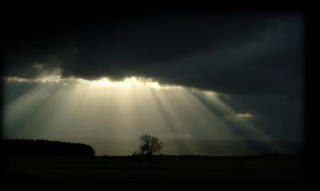
Next, look up. Try to imagine that the sky doesn't go on forever. It's hard. In fact, it's a little depressing. The sky has always represented freedom, even heaven to some. When the hero dies in old movies, the camera pans upwards, the music swells and god is in his heaven as evidenced by the glorious sunbeams breaking through the clouds. But forget all that - try to imagine that the bulk of the stuff we depend upon is actually below 10 to 11km altitude (much lower at the poles), and that is a distance a brisk walker could travel in little more than an afternoon (if it were distance on the ground). Imagine also that our atmosphere in relation to a standard sized globe is as thin as a few coats of thick varnish. Beyond that is void.

We know that the earth is a finite system. We know we're having an effect on the ecosystems and oceans of the world. It seems to me that we can no longer treat the atmosphere as we have been treating the oceans - as dumping grounds. When the scientists state that we are affecting the very climate of the earth, I for one am prepared to take them very seriously.

p.s. so now that you've visualised the air and sky above as a layer in which we 'swim', try to combine it with your new 'earth as a ball' perception. Have fun ;-)
Powered by Blogger.